
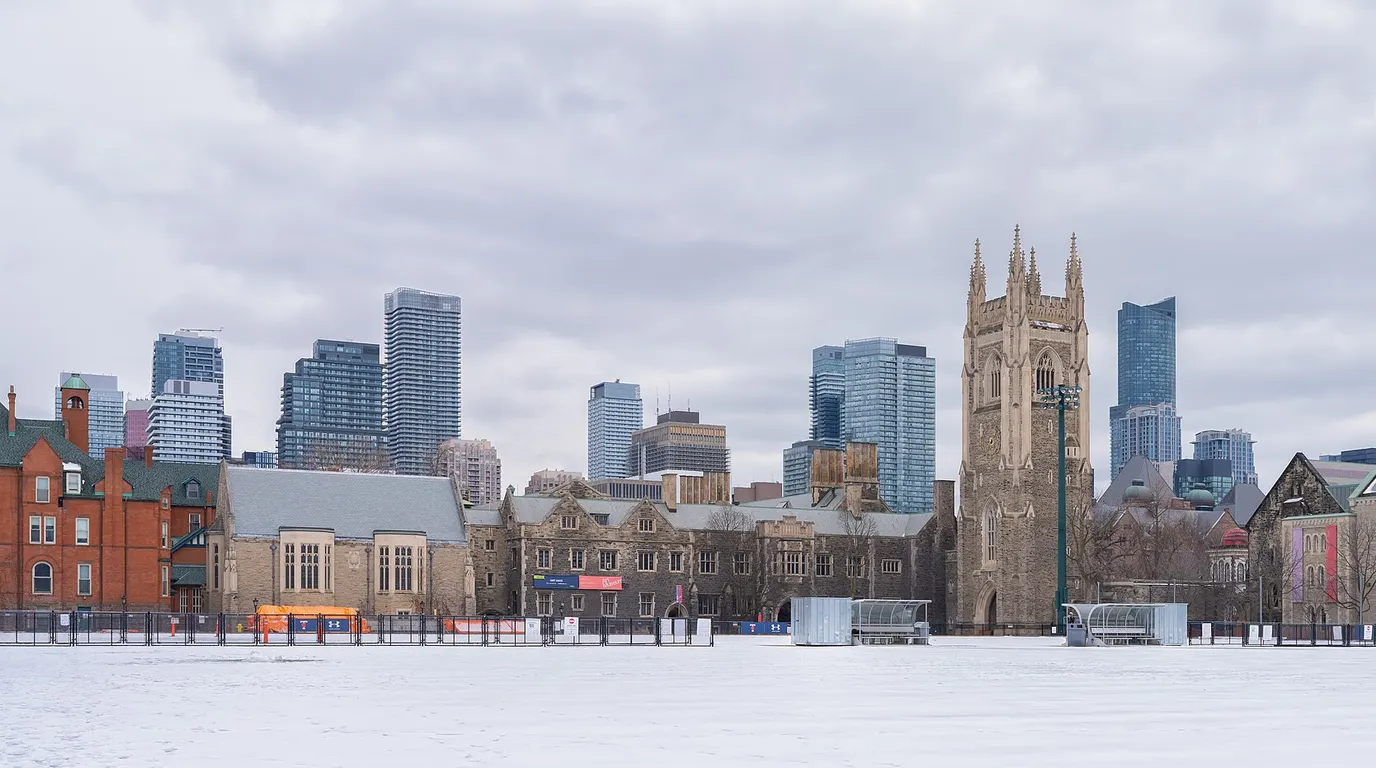
 © Jchmrt · CC BY-SA 4.0
On this page
Why Canada?

Advantages
- Public schools and healthcarePublic schools are free; permanent residents get provincial health insurance and domestic university fees.
- A large Chinese communityAbout 1.7 million Chinese Canadians (2021 census), concentrated in Vancouver and Toronto.
- Safe14th of 163 on the Global Peace Index 2026.
- Citizenship in about 3 yearsApply after 1,095 days in Canada within 5 years; Canada allows dual nationality.
Worth weighing up
- High taxesCombined federal and provincial top rates are about 44.5% to 54.8%, on worldwide income.
- Cold wintersFour seasons with cold winters; Vancouver is milder but wetter.
- Tough from abroadMost Express Entry invitations go to Canadian experience, provincial nominees, French speakers and listed jobs; applicants abroad rarely get in on score alone.

Who is it for?
- You want to move to Canada on your education, work experience and English
- You study or work in Canada and want to stay as a permanent resident
- You want to move the family and school the children in Canada's public schools
- You speak French or work in healthcare, STEM, education or a trade and want the category draws
Key facts
- 1How you qualify
- One of FSW, CEC or FST, in a TEER 0–3 job
- CLB 7 in English or French (CLB 5 for some CEC jobs)
- FSW: 1 continuous year in 10; CEC: 1 year in Canada within 3
- Invited by CRS score and draw category; cut-offs vary, so an invitation is not guaranteed
- 2Family who can come
- Your spouse or common-law partner
- Unmarried dependent children under 22
- Your partner's dependent children
- 3Settlement and passport
- Permanent residence once approved and landed
- Citizenship: 1,095 days in Canada in 5 years (730+ as a PR)
- 4How long it takes
Invitation
Score-based
Permanent residence
On landing
Citizenship application
About 3 years later
✓ Facts checked: 2 Nov 2026
Toolbox
Does your job qualify?
Type your job or industry and an adviser will tell you on WhatsApp whether this route fits, what to check about your job and salary, and which route suits you best.
What you type only goes into the WhatsApp message; we don't store it anywhere else.
- Upcoming
New points for high-wage experience and job offers; no LMIA needed
12 months of Canadian experience in a high-wage TEER 0–3 job adds 20, 40 or 70 extra points at 1.3, 1.5 or 2 times the median wage; a qualifying high-wage job offer adds 50, 70 or 100 points with no LMIA. Only the higher of the two counts, capped with Canadian-experience points at 150 (140 with a partner).
Source: IRCC — Changes to Express Entry for high-wage occupations (16 Oct 2026)
Job offers no longer add CRS points
Valid job offers used to add 50 or 200 points; this ended on this date. A job offer still matters for FSW and FST eligibility and some provincial streams.
Source: CIC News — Canada removes bonus CRS points for arranged employment (25 Mar 2025)
Category-based selection launched
IRCC began inviting people in set categories, such as French speakers, healthcare, STEM, trades, transport and agriculture, often at lower scores.
Source: IRCC — Canada launches category-based selection (31 May 2023)
Job-offer points cut; Canadian study earns points
A valid job offer dropped from 600 points to 50 (200 for senior management), and post-secondary study in Canada began earning 15 to 30 points.
Express Entry launched
Canada launched Express Entry to manage the Federal Skilled Worker, Canadian Experience Class and Federal Skilled Trades programmes and part of the provincial nominee programmes, inviting people to apply for PR by score.
Source: IRCC — Minister transition binder 2023: economic immigration
Eligibility and family
- Federal Skilled Trades covers listed trades only
- Language results must come from an approved English or French test
- FSW: score at least 67 selection points and hold secondary education or higher; foreign degrees need an Educational Credential Assessment
- FSW and FST applicants without Canadian work authorisation or a job offer must show settlement funds
Family members who can be included
| Family member | Condition |
|---|---|
| Spouse or common-law partner | Must be declared, even if they are not coming with you |
| Dependent children | Under 22 and not married or in a common-law relationship; age is locked in on the date the PR application is received |
| Your partner's dependent children | Also declared, and counted in your family size |
Process and timetable
Before applying
Language, credential check and score
Take a language test, get your overseas education assessed, and estimate your CRS score to see which draws suit you.
Month 0
Create your Express Entry profile
Enter your education, work and language results online; if eligible you join the pool. Profiles last 12 months and can be recreated if no invitation comes.
In the pool
Raise your score and wait
A provincial nomination adds 600 points; French, Canadian work experience and your spouse's profile also help. IRCC draws regularly by score and category.
Within 60 days of invitation
Apply for permanent residence
Submit the full application with medicals, police certificates, proof of funds and work evidence. Invitations last only 60 days, so prepare early.
After applying
Biometrics and processing
Applicants aged 14 to 79 give fingerprints and a photo within 30 days of the request letter.
Approval
Land as a permanent resident
Land in Canada before your deadline.
After about 3 years
Apply for citizenship
You need 1,095 days in Canada in the 5 years before applying, at least 730 as a permanent resident; days as a temporary resident count as half days, up to 365.

For your profile
- A valid passport (renew it if it expires within 6 months)
- Language test results
- An educational credential assessment: required for FSW, or to get points for education outside Canada
- Proof of work experience, such as reference letters from employers
- A written Canadian job offer, provincial trade certificate or provincial nomination, if you have one
For the PR application
- Proof of funds (FSW and FST)
- Police certificates
- Biometrics for everyone aged 14 to 79
Source of funds and the proof needed
| Source of funds | Proof needed |
|---|---|
| Bank and investment accounts | An official letter on letterhead from each institution, with its contact details, your name, your outstanding debts and details of each account |
| Amount needed | Set by family size: CA$15,263 for 1, CA$19,001 for 2, CA$23,360 for 3, CA$28,362 for 4, and about CA$4,112 for each extra person |
| When it must be available | Both when you apply and when the PR visa is issued |
| Not needed | Canadian Experience Class, or authorised to work in Canada with a valid job offer; upload a letter explaining this |
Government costs and investment
| Item | Amount |
|---|---|
| Processing fee (principal / partner) | CA$990 each |
| Processing fee (dependent child) | CA$270 each |
| Right of permanent residence fee | CA$600 per adult |
IRCC fees from 30 April 2026. Language tests, credential assessment, medicals, biometrics and translation are extra; Lighthouse fees are quoted in writing after the free assessment.
Canada · Country snapshot
Basics
- Population
- About 41.8 million (July 2026)
- Chinese population
- About 1.7 million, around 4.7% (2021 census), concentrated in Vancouver and Toronto
- Language
- English and French (French in Quebec)
- Currency
- Canadian dollar (CAD)
- Time difference
- Vancouver 16 hours behind Hong Kong, Toronto 13 (one less in summer)
- From Hong Kong
- Direct flights to Vancouver and Toronto
Tax
- Income tax
- Federal 14%–33% progressive plus provincial; combined top rate about 44.5%–54.8% (Ontario and BC 53.5%)
- Corporation tax
- Federal 15%, combined 23%–30%; small business 9%–12.2% on the first CA$500,000
- Capital gains tax
- 50% of the gain is taxed as income (a principal residence is usually exempt)
- Purchase taxes
- Provincial land transfer tax about 0.04%–5%, plus a Toronto municipal tax; the ban on non-Canadians buying homes runs to 1 Jan 2027
- Annual property tax
- Municipal tax on assessed value; BC also has a speculation and vacancy tax
- Inheritance tax
- No estate or gift tax, but assets are deemed sold at death, which can trigger capital gains tax; most provinces charge probate fees
- Worldwide income
- Yes, residents are taxed on worldwide income
- Tax residence
- Based on residential ties such as a home, spouse and children in Canada; 183 days or more in a calendar year also makes you resident
- CRS
- Participates
Living
- Education
- Free public schools; permanent residents pay domestic university fees
- Healthcare
- Provincial public health insurance for permanent residents; some provinces have a waiting period
- Safety
- Global Peace Index 2026: 14th of 163
- Climate
- Four seasons with cold winters; Vancouver is milder and wetter
- Dual nationality
- Allowed by Canada
- Passport access
- 182 destinations (Henley 2026)
Tax figures are a general guide, not tax advice; your position depends on your circumstances.
Sources · Checked 30 Oct 2026
- Statistics Canada — Canada's population estimates, July 1, 2026
- Statistics Canada — A statistical snapshot of Asians in Canada
- PwC Worldwide Tax Summaries — Canada, individual and corporate taxes (reviewed 12 Jun 2026)
- PwC Worldwide Tax Summaries — Canada, individual residence
- CIC News — Canada extends foreign home buyer ban until 2027
- Stephenson Harwood — Cancellation of Canadian capital gains inclusion rate increase
- Institute for Economics & Peace — Global Peace Index 2026
- Henley Passport Index 2026 (via Wikipedia)

Want to know if this programme fits you?
Tell us your situation and a consultant will compare this programme with your other options.

Things to watch
General draws are rare; categories decide
Most 2026 invitations went to the Canadian Experience Class, provincial nominees, French speakers and listed occupations. Applicants abroad without French or a listed occupation rarely reach the cut-off on CRS alone, so consider a provincial nomination or studying and working in Canada first.
Proof of funds changes yearly
Funds are usually updated each year by the low-income cut-off; as of October 2026, IRCC still used the July 2025 amounts. When they change, candidates in the pool often get only a few weeks to update, so check the current amount and source-of-funds documents before applying.
Quebec is separate
If you plan to live in Quebec, apply through Quebec's own skilled programmes, not Express Entry.
Frequently asked questions
What CRS score do I need?
It depends on the draw. In September–October 2026 the Canadian Experience Class cut-off was about 518–519, French draws 407–435, and provincial nominee draws above 700 because a nomination adds 600 points. Without a category advantage you usually need a very high score.
Can I apply without a Canadian job offer?
Yes. FSW and CEC do not require a job offer. Job offers stopped earning points in March 2025, but from 3 November 2026 a qualifying offer paying at least 1.3 times the median wage adds 50 to 100 points, with no LMIA needed. FST does need a job offer or a provincial certificate of qualification.
Do Hong Kong applicants have any advantage?
Express Entry does not score by nationality. Hong Kong applicants usually gain from English scores, degrees and professional experience; with a year of Canadian work, the Canadian Experience Class is open. The Hong Kong-only Streams A and B closed to new applications on 31 August 2026.
How much money do I need?
FSW and FST applicants without Canadian work authorisation or a job offer must show settlement funds: CA$15,263 for one, CA$28,362 for four (since July 2025), plus IRCC and third-party fees.
Can my family come too?
Yes. Your spouse or common-law partner and dependent children can be included, and your partner's education, language and Canadian experience can add points.
How long does an Express Entry profile last?
A profile lasts 12 months; if you are not invited it expires and you can create a new one. Once invited, you have 60 days to submit your PR application.
Compare with
Related news
Sources · 17 items · Facts checked: 2 Nov 2026
- OfficialIRCC — Minister transition binder 2023: economic immigration
- OfficialIRCC — Express Entry Year-End Report 2016
- OfficialIRCC — Canada launches category-based selection (31 May 2023)
- OfficialIRCC — Express Entry: get your documents ready
- OfficialIRCC — Express Entry: proof of funds
- OfficialIRCC — Express Entry: apply for permanent residence
- OfficialIRCC — Express Entry: after you apply
- OfficialIRCC — Citizenship: who can apply
- OfficialIRCC — New definition of age of dependants now in force (24 Oct 2017)
- OfficialIRCC — Express Entry: who can apply (programme comparison)
- OfficialIRCC — Supplementary information for the 2026–2028 Immigration Levels Plan
- OfficialIRCC — Changes to Express Entry for high-wage occupations (16 Oct 2026)
- SecondaryCIC News — Canada hikes permanent resident fees (Apr 2026)
- SecondaryMoving2Canada — Express Entry funds requirement to increase soon (Aug 2026)
- SecondaryFragomen — Canada updates Express Entry category-based selection for 2026
- SecondaryCIC News — Canada removes bonus CRS points for arranged employment (25 Mar 2025)
- SecondaryMoving2Canada — Express Entry draw history (Oct 2026)
Official sources take priority; secondary sources are used only to fill gaps and are replaced with official ones when we next check.