
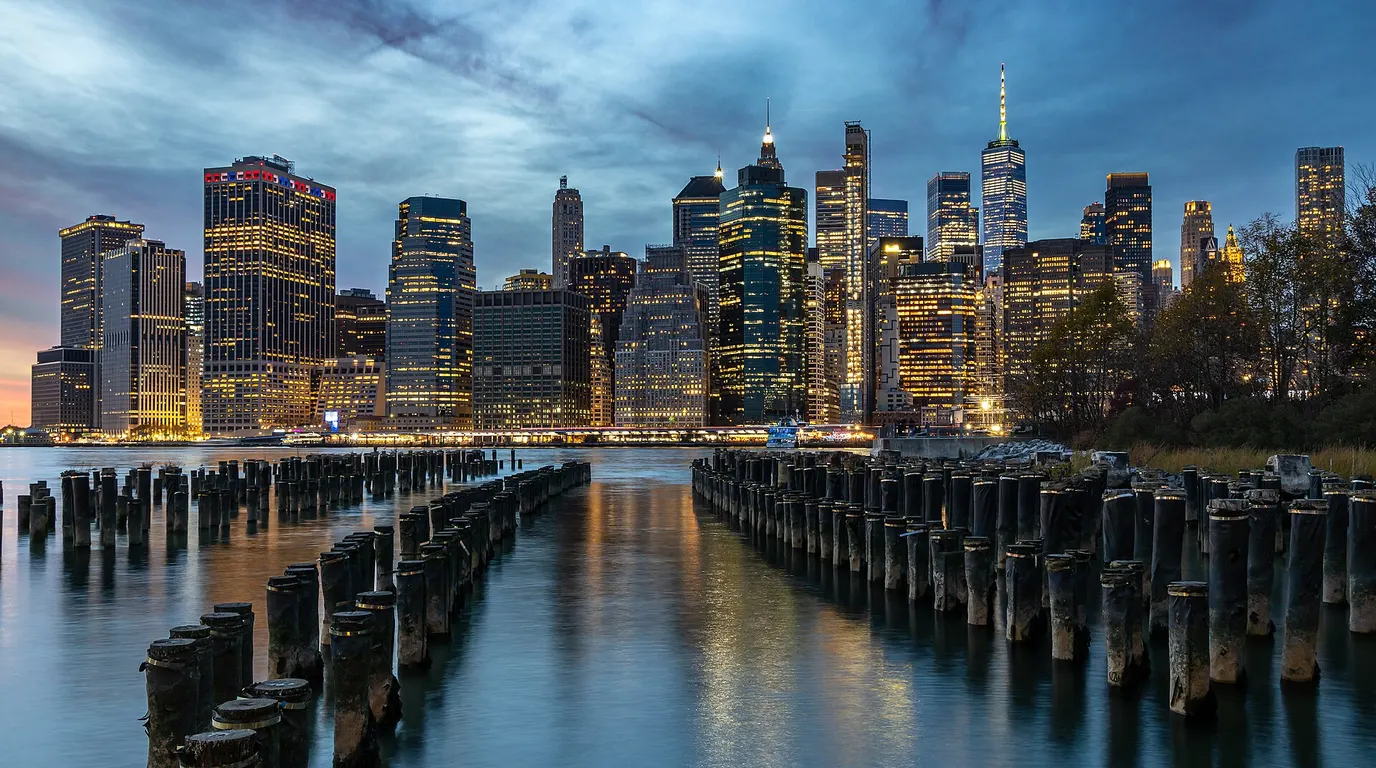
 © Superbass · CC BY-SA 4.0
On this page
Why USA?

Advantages
- A green card through investmentFrom US$800,000 and 10 jobs created, the EB-5 covers the whole family with green cards.
- Top universities and marketsMany of the world's top universities and its deepest capital markets are in the US.
- Dual nationality allowedYou can keep your Hong Kong status and original nationality after naturalising.

Worth weighing up
- Worldwide taxationGreen card holders are taxed on worldwide income and must report overseas assets.
- Expensive healthcareCare runs on private insurance and costs far more than in Hong Kong.
- Safety varies by cityOverall safety rankings are low and vary widely by area.

Who is it for?
- You want your children to study and work in the US
- You have no US employer but have capital to invest
- You want green cards for the family, and citizenship later
Key facts
- 1How you qualify
- US$800,000 in a targeted employment area (rural or high unemployment) or infrastructure project; US$1,050,000 elsewhere
- The investment must create or preserve 10 full-time jobs
- Show the lawful source of the money
- 2Family who can come
- Your spouse
- Unmarried children under 21
- 3Settlement and passport
- A two-year conditional green card, then apply to remove the conditions
- Citizenship can be applied for 5 years after the green card
- 4How long it takes
Investor petition (I-526E)
Per USCIS's latest times
Conditional green card
Two years, subject to visa availability
Permanent green card (I-829)
File in the 90 days before the conditional card expires
✓ Facts checked: 6 Nov 2026
Latest developments
EB-5 Reform and Integrity Act signed
Investment amounts were set at US$800,000 (targeted areas and infrastructure) and US$1,050,000, the Regional Center Program was reauthorized to 30 Sep 2027, and 20%, 10% and 2% of visas were set aside for rural, high-unemployment and infrastructure projects.
Source: USCIS — About the EB-5 Visa Classification (updated 18 Nov 2025)
Court vacates the 2019 rule
A federal court vacated the 2019 rule that had raised the amounts to US$900,000 / US$1.8 million, and USCIS returned to the earlier regulations.
Modernization rule raises amounts
A Homeland Security rule raised the amounts to US$900,000 (targeted areas) and US$1.8 million; it was later vacated by a court.
Regional Center Program created
Congress created the Regional Center pilot, letting investors invest through approved regional centers and count indirect jobs.
Congress creates EB-5
Congress created EB-5 to stimulate the US economy through foreign investors' capital and job creation.
Eligibility and family
- Invest in a new commercial enterprise set up after 29 Nov 1990 (or restructured or expanded)
- US$800,000 in a targeted area or infrastructure project, or US$1,050,000 elsewhere
- Create or preserve 10 full-time jobs (35+ hours a week); up to 90% may be indirect for regional center investors
- The money must be lawfully obtained and yours; no guaranteed return or repayment promise
Family members who can be included
| Family member | Condition |
|---|---|
| Spouse | Included for a green card |
| Unmarried children under 21 | Included; a child who turns 21 or marries can no longer come as a dependant |
Process and timetable
Step 1
Invest and file the I-526E
Invest through a regional center or directly, and file the investor petition with your source-of-funds evidence.
Once approved
Consulate interview
When a visa is available, you and your family are interviewed at a US consulate and issued immigrant visas.
Entry
Enter and get conditional green cards
Enter the US on the immigrant visa and receive two-year conditional green cards.
After 2 years
I-829 for permanent green cards
File in the 90 days before expiry, showing the investment and jobs.
Step 1
Invest and file the I-526E
For people already in the US with lawful status, such as students or work-visa holders.
At the same time
File to adjust status at the same time
If eligible, file the green card application at the same time, and apply for work and travel permission while you wait.
Approval
Conditional green card
Receive the two-year conditional green card in the US, without a consulate interview abroad.
After 2 years
I-829 for permanent green cards
File in the 90 days before expiry, showing the investment and jobs.
Government costs and investment
| Item | Amount |
|---|---|
| Investment: targeted area or infrastructure | US$800,000 |
| Investment: elsewhere | US$1,050,000 |
| I-526E filing fee + separate fee | US$3,675 + US$1,000 |
| I-829 filing fee | US$3,750 |
These are from USCIS's fee schedule (October 2026 edition); green card, medical and consular fees are extra. Regional center projects usually charge an administration fee, and the investment is at risk, with no guaranteed return. Legal fees and Lighthouse's service fee are extra; we quote our fee in writing after the free assessment.

USA · Country snapshot
Basics
- Population
- About 340 million (2025 estimate)
- Chinese population
- About 5.5 million Chinese Americans
- Language
- No official language federally; English is dominant, Spanish is common
- Currency
- US dollar (USD); about HK$7.8 under the linked exchange rate
- Time difference
- East Coast 12–13 hours behind Hong Kong, West Coast 15–16 hours (daylight saving applies)
- From Hong Kong
- Direct flights to New York, San Francisco and Los Angeles, about 12–16 hours
Tax
- Income tax
- Federal 10%–37% progressive; state tax extra (0%–13.3% depending on the state)
- Social security
- Social Security 6.2% and Medicare 1.45% (employee share; employer pays the same)
- Corporation tax
- Federal 21%; state tax on top
- Consumption tax
- No federal sales tax; combined state and local sales taxes run about 0%–10%
- Capital gains tax
- Long-term capital gains 0%/15%/20%, plus a 3.8% net investment income tax for high earners
- Stamp duty on purchase
- No federal stamp duty; some states and cities charge a transfer tax
- Annual property tax
- Varies by state, averaging about 1% of the property's value
- Inheritance tax
- Federal estate tax 40% above an exemption of about US$15 million (2026); some states levy their own
- Worldwide income
- Yes, citizens and tax residents are taxed on worldwide income and must report overseas assets (FBAR/FATCA)
- Tax residence
- Green card holders, or those meeting the substantial presence test (183 weighted days over three years)
- CRS
- Not in CRS; automatic exchange runs through FATCA
Living
- Education
- State schools are free; university is expensive, with many of the world's top institutions
- Healthcare
- Mostly private or employer insurance; Medicare for over-65s and Medicaid for low incomes
- Safety
- Global Peace Index 2026: 132nd (gun violence weighs on the score)
- Climate
- Varies widely: four seasons in the north-east, mild on the west coast, hot in the south
- Citizenship / passport
- Green card holders can naturalise after 5 years (3 if married to a US citizen), then apply for a passport
- Dual nationality
- Allowed by the United States
- Passport access
- About 186 destinations (Henley July 2026, ranked 9th)
Tax figures are a general guide, not tax advice; your position depends on your circumstances.
Sources · Checked 13 Nov 2026
- US Census Bureau — Population estimates
- Internal Revenue Service — Federal income tax rates and brackets
- Internal Revenue Service — Corporations
- Internal Revenue Service — Topic no. 409, Capital gains and losses
- Internal Revenue Service — Estate tax
- Centers for Medicare & Medicaid Services — Health care coverage
- US Department of Education
- US Department of State — Bureau of Consular Affairs
- Institute for Economics & Peace — Global Peace Index 2026
- Henley & Partners — Henley Passport Index 2026 July Global Ranking

Want to know if this programme fits you?
Tell us your situation and a consultant will compare this programme with your other options.
Things to watch
Amounts may rise in 2027
The amounts adjust for inflation every five years, first for petitions filed on or after 1 Jan 2027; the Regional Center Program's authorization also ends on 30 Sep 2027 unless Congress extends it.
Waiting times depend on birthplace
Green cards are allocated by country of birth and some face waits; we estimate yours from the State Department's latest Visa Bulletin at the assessment.
The investment is at risk
EB-5 requires the money to be at risk with no guaranteed return; check projects carefully.
Men must register for Selective Service
Men aged 18 to 25 living in the US, including green card holders, must register with Selective Service; registering is not the same as being drafted.
Frequently asked questions
What is the minimum investment?
US$800,000 in a targeted employment area (rural or high unemployment) or infrastructure project; US$1,050,000 elsewhere.
Do I have to run a business?
Regional center investors usually don't run the business, and indirect jobs can count; a direct investment must itself employ the 10 people.
Do I need English or a degree?
No. EB-5 has no degree, English or work-experience requirement; it focuses on the investment and the lawful source of funds.
What if my child is nearly 21?
Children must be under 21 and unmarried to be included. The law has an age-protection calculation; we plan early around your situation at the assessment.
What is a conditional green card?
The first green card lasts two years with conditions; file the I-829 in the 90 days before it expires, showing the investment and jobs, to get a permanent one.
Can I become a citizen?
Yes. Five years after the green card, you can apply if you meet the residence and other requirements; the conditional period counts.
Is there military service?
The US has no active draft, but men aged 18 to 25 living in the US, including green card holders, must register with Selective Service.
Compare with
Sources · 7 items · Facts checked: 6 Nov 2026
- OfficialUSCIS — EB-5 Immigrant Investor Program
- OfficialUSCIS — About the EB-5 Visa Classification (updated 18 Nov 2025)
- OfficialUSCIS — G-1055 Fee Schedule (edition 10/26/26): I-526E and I-829
- OfficialUSCIS — I-829, Petition by Investor to Remove Conditions on Permanent Resident Status
- OfficialUSCIS — Citizenship through naturalization
- OfficialUS Department of State — Visa Bulletin
- OfficialSelective Service System — Who needs to register
Official sources take priority; secondary sources are used only to fill gaps and are replaced with official ones when we next check.